East Hampton - An entirely new audience is getting to know The Beales of East Hampton, a mother and daughter duo that has, over the last four decades, become the highest order of Hamptons folklore. Portrayed by Jessica Lange and Drew Barrymore, respectively - it is the story of Edith and "Little" Edie Beale and their infamous, dilapidated home in the exclusive
Georgica Pond section of East Hampton known by neighbors as "Grey Gardens." Eccentrics in a rundown mansion, unto itself, is not much of a story. However, when the eccentrics are the aunt and first cousin of Jacqueline Bouvier Kennedy Onassis and Princess Lee Raziwell, the story becomes nothing short of sensational.
 |
For Little Edie, although there were three attempts at escape, the connection to her mother was intrinsic and unbreakable. Photo Hulton Archive, Jan. 1975 |
The story of the Beales and Bouviers in the East Hampton can be traced back to the 1920s, when they laid down summer roots at four different homes. New York stockbroker M.C. Bouvier was the family patriarch, at the time being the father of Major Bouvier who was the father of Jackie's father, John Vernou "Black Jack" Bouvier and his sister Edith Ewing Bouvier Beale, having married Phelan Beale, a prominent New York attorney who worked at her father's law firm, Bouvier and Beale.
In 1923 Beale bought "Grey Gardens" just after Edith had given birth to the last of her three children: Phelan Beale, Jr. (1920), Bouvier Beale (1922), and her first born pride and joy, her namesake daughter, Edith Bouvier "Little Edie" Beale (1917). An intermarriage of the Social Register, the families were a presence in Manhattan and East Hampton high society. Whatever personal peccadilloes may have existed in the family closet (extramarital affairs, alcoholism, financial excess), on the surface they were Maidstone Club mainstays.
The exception to the literal family rule was Edith, who was a free spirit and self professed "artist" and chanteuse who was bored by Maidstone ladies' luncheons and social dances. Her only partner in disdain for the Hampton's social mores of the day was her daughter and she did her best to cultivate Little Edie's flamboyant eccentricities fashioned in her own image. From impromptu and more pointedly uninvited song and dance performances at social events to exotic and sometimes provocative apparel choices, the Beale women were anything but the proper, female wallflowers of the era. Her family, the Bouviers, and her husband Phelan were not at all happy with Edith's behavior.

The Bouviers survived the depression by the skin of their teeth and with the death of the patriarch, M.C. in 1935 the family re-found its financial footing. As fate would have it, just around the same time, Edith's husband found a hunting lodge in East Hampton's Northwest woods and abandoned the family now ensconced at "Grey Gardens," providing limited child support and nothing more to maintain the mansion and their lifestyle. Eventually securing a "Mexican" divorce, Edith relied on her father for financial support. Her eccentric behavior eventually brought even that to an end, specifically when she showed up late (half-way through the ceremony) for her son Bouvier's wedding dressed up as an opera star. Upon Major Bouvier's death in 1948, Edith's inheritance amounted to nothing more than a $65,000 trust fund, which was controlled by her sons. This modest trust, along with the gradual selling off of her Tiffany jewelry, sustained the already reclusive Edith and her daughter at "Grey Gardens" for the next 23 years.
The Beale boys, unlike their older sister, found their way in the world. They established, for better or worse, fairly successful lives for themselves outside the magnet of their mother's demonstrative and provocative personality. For Little Edie, although there were three attempts at escape, the connection to her mother was intrinsic and unbreakable. Despite a turn at Miss Potter's School, an apartment at the Barbizon, a theatrical audition set up by Max Gordon, moderate success at modeling for Macy's and the photographer Bachrach, a time dating
Howard Hughes and claimed wedding proposals from Joseph Kennedy, Jr. and J. Paul Getty, the suffocating love of and for her mother drew Little Edie back to "Grey Gardens" and the unimagined cult fame that was to eventually unfold.


Aside from the ongoing small town gossip, the story of "Grey Gardens" first came to light in the local papers when on Oct. 22, 1971, the East Hampton town fathers enlisted the help of Suffolk County officials and descended upon the mansion for a forced inspection. Two days earlier, a smaller group of five local inspectors had tried to enter the house, but were denied access by a screaming Edith from the second floor bedroom. At the direction of Village Deputy Mayor Dr. William Abel and with an East Hampton Town Justice search warrant based on the accusation of "harboring diseased cats" in hand, they returned with a battalion of 12 officials ranging from the ASPCA to the County Health Department.
The officials found at least a dozen cats and their accumulated feces covering the floors, a five foot-high pile of empty cans of cat food in the kitchen, an antiquated and non-working furnace, a Sterno stove sitting on Edith's newspaper and magazine covered bed, raccoon holes in the ceiling, cobwebs upon cobwebs lacing extraordinary filth everywhere. Literally every building code violation imaginable was found and, according to one of the ASPCA inspectors who was not doubled over in sickness from the stench, human fecal matter in the upstairs bedroom. This was the lifestyle of the rich and famous? Well, in the case of these relatives of the Kennedy's Camelot, mind-boggling yes, indeed.
 |
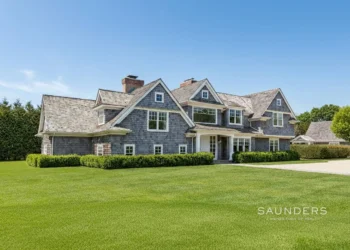
The "Grey Gardens" Georgica Estate of East Hampton as it appears today. Photo by Diane Roncone |
The Beale's story first drew detailed national attention with Gail Sheehy's brilliant article, "The Secret of Grey Gardens" in
New York Magazine, (Jan. 10, 1972). This was one of those great, unexpected, tripped upon stories that came out of being in the right place at the right time. In the summer of 1971 Sheehy and her family rented a house in Georgica Pond and frequently walked past "Grey Gardens" on their way back from Georgica Beach. The landscape overgrown, as if dragging the building back into the earth like an abandoned, post civil war plantation house, it was a structure in extreme disrepair that her daughter called the "Witch House." The Sheehys existed in dispassionate ambivalence of their eccentric neighbors until a box full of baby rabbits were found along the side of the road. Sheehy, upon her daughter's suggestion, decided to ask the Beales if they would be willing to take the rabbits, as they already had an obvious passion for animals - 12 cats in all. The rest is history, as Sheehy and Little Edie embarked upon a personal relationship that would prove to be the basis of one of the seminal articles of Tom Wolfe's described "new journalism."
After a summer of front porch socializing with the Beales, Sheehy returned with her family back to Manhattan. She first heard of the Beales eviction plight in a
New York Post headline that read, JACKIE'S AUNT TOLD: CLEAN UP MANSION. Unable to reach the Beales out-of-order phone, Sheehy headed out to East Hampton finding gawking press hounds staking out the house for a glimpse of the Kennedy's ne'er-do-well by marriage relatives.
 |
Mourning the death of John F. Kennedy from their yellow bedroom, movie version "Big" Edith Bouvier Beale (Jessia Lange) and "Little" Edith Bouvier Beale (Drew Barrymore). Photo courtesy of Peter Stranks/HBO |
Finally reaching Little Edie by telephone the next morning, Sheehy listened as Edie pleaded, "We're artists against the bureaucrats. Mother's French operetta. I dance, I write poetry, I sketch. But that doesn't mean we are crazy or taking heroin or anything. Please, please tell them what we are." Of course, that is exactly what Sheehy did. Although it cannot be verified, it is probably safe to assume it was her article in
New York Magazine that finally moved the Beales famous kin into the action of rescuing their forlorn relatives, as Onassis and Radziwell put up $32,000 to bring "Grey Gardens" up to code and avert the impending eviction. Over 1,000 bags of garbage were removed from the house during the clean-up. A clean-up that only lasted as long as the next inspection, as the Beales had no intention of altering their lifestyle or habits.
 |
The famed Spanish Garden - walled garden of Grey Gardens (Photo circa early 1920s) from Forty Years of Gardening. |
At least the distant relatives stepped up to the plate, as the immediate family had no intention of helping. When Edith's sons, who controlled the trust, were alerted the previous February by East Hampton Village Building Inspector A. Victor Amann that the house was in violation and that the overgrowth had to be cut back, which the village would take care of for $5,000, he was told the trust fund had no money left. The trust also received a notice from P.C. Schenck Fuel Oil of East Hampton that the furnace was unsafe and not working, along with an unpaid bill of $800. Neither problems were addressed by the trust.
Sidney Beckwith of the Suffolk County Health Department gave a courtesy call to Bouvier Beale alerting him that a third inspection, scheduled for Dec. 7, would inevitably lead to an eviction and "a national scandal." Beale's response was, "If that is what it takes to get mother out of the house, so be it."
The real fame, if you can call it that, came in 1975 with the Maysles Brothers' film documentary "Grey Gardens." In a recent interview in
Vogue, Lee Radziwell, after viewing a private screening of the upcoming HBO special, shed some light on the geneses of the original Maysles project. After 20 years in London, Radziwell wanted to return to the United States and do a documentary reliving the places she had grown up around and loved, using her Aunt Edith as a resource for East Hampton.
 |
David and Albert Maysles with "Big and Little Edie" during the filming of their legendary documentary, 1975 © Photo courtesy of Maysles Films. |
After renting Andy Warhol's Montauk house with photographer Peter Beard, they contacted the Maysles Brothers with the idea. Unfortunately for Radziwell, after meeting the Beale women and seeing the mansion, the brothers had a totally different idea for a documentary. Their live-to-film treatment is one of the most amazing, unsettling and revealing depictions of lives lost to ruin and self-delusion ever captured on film.
Undoubtedly, they encouraged the women to vamp it up, but there is no doubt that the audience gets a birds-eye-view of the Beales psyche. From Edith's contralto singing atop her flea infested and refuse covered bed to Little Edie's flag waving interpretative dance number in the foyer - from the whispered, disconnected paranoid rambling to high-pitched, frenetic argumentative rants - the film portrays a co-dependent relationship that is as loving as it is destructive.
Even though the women never saw a penny from it, the film became a cult classic and created international fame for Edith and Little Edie. The fame they had sought a lifetime to achieve based on their self-perceived talents was finally manifest in their self-imposed exile from accepted society. At the time of its release it was rumored that Radizwell wanted the negative of the Maysles film destroyed, but when asked in the interview if she was ever embarrassed by the Beales, she was adamant in her response. "Never. You couldn't possibly be ashamed of them, you celebrated them. I am very proud of the Beales. They made their lives into what they wanted, which was fantasy. They had no complexes about the condition of their house or themselves. They were really happy not comparing themselves to anybody else."
 |
Fame came in its dubious manner to Grey Gardens, immortalized in numerous film adaptations. |
Edith got her wish and held on to "Grey Gardens" until her death at age 81 in 1977, just two years after the film's release. She fell at home, died at
Southampton Hospital and is buried at Most Holy Trinity R.C. Cemetery in East Hampton. Little Edie put the house on the market, but refused to sell it to anyone who wanted to tear it down and build a McMansion on the site. In 1979
Washington Post Executive Editor Ben Bradlee and his wife, journalist Sally Quinn, were in the market for a new house in the Hamptons. Even though the real estate agent handling "Grey Gardens" was desperate to sell it, she refused to actually enter the house. She showed it to Quinn who was greeted by Little Edie at the door in one of the signature scarfs that constantly covered her hairless head, which was the result of a stress-borne illness or, according to her cousin John Davis, an act of self-immolation with a lighter in a catalpa tree. Although still filthy, cat infested and in disrepair, Quinn fell in love with the house's possibilities and agreed to renovate rather than tear down. They closed on the house a few months later and in November 1979 Little Edie walked out of "Grey Gardens" taking nothing with her but memories.
The Bradlees renovated the house at 3 West End Avenue back to its original splendor and rent it 11 months out of the year to
Frances Hayward.
Little Edie Beale was finally free from her mother, but the years of self-conceived delusional talent and social isolation had not prepared her for the world she had left behind years earlier. In 1978 she embarked on a cabaret career at the age of 60, performing eight shows at Reno Sweeny in Manhattan. The
New York Times called it "a public display of ineptitude" and the club kept the reviews from her. After leaving "Grey Gardens" she took a small cottage in Southampton before moving into a studio apartment on the Upper East Side where she lived from 1980 to 1983. She left Manhattan for Florida and years later, in an attempt to master French, lived briefly in Montreal in the mid 1990s. After a short stay with relatives in Oakland, California, she returned to Bal Harbour, Florida in 1997 where she was found in her apartment in 2002 at the age of 84, five days after she had died.
Surprisingly, Little Edie did not want to be buried with her mother. She was cremated and after a memorial service in East Hampton, her remains were interred in Locust Vally next to the grave of her brother Bouvier.
Over the years the legend of the Beales has grown to include several books on their lives, fan clubs, collectible memorabilia and a successful Broadway play that garnered its stars,
Christine Ebersole as Little Edie and Mary Louise Wilson as Edith, two Tony Awards. The HBO movie, directed by Michael Sucsy, is the proverbial icing on the cake with two high-powered and accomplished stars in the roles. The movie goes beyond the Maysles film, as it is not only documents the making of their film and the relationships they forged with the Beales, but provides beautifully crafted flashbacks to the women's lives at the height of their high society days, before the isolation and deprivation that was to consume them at "Grey Gardens." It is a story of greed, passion, excess, despair, loyalty, disillusionment, destructive attachments, abandonment, and yes, love and moments of sheer joy. It is the story of two of the most remarkably eccentric women that have ever called East Hampton home.
Guest (Sheila & Dave) from SF SD says:
Just finished viewing the show "Grey Gardens" and my husband and I totally related to the wonderful Beale ladies. As it was noted, .."there is mental illness as many people their are..." the original documentary may have been questionable and we intend to view that but the HBO depiction gives the audience, perhaps, a whole perspective for our regards towards each other in our good times and bad times. I my self had grown up in much dysfunction due to circumstances that may have been more to the causes of the disarray my mother had with mental illness. She indured many misdiagnoses and experimental medications that I had learned about later in life that caused her more problems and helping her. My story is rather involved also that I to would appreciate sincere persons of documentary reporting to take down. People need to know of people and their conditions and be respectful to truly understanding them. Life goes on and so will the wonderful memories we all share. Thank you...
Posted: 87 days ago